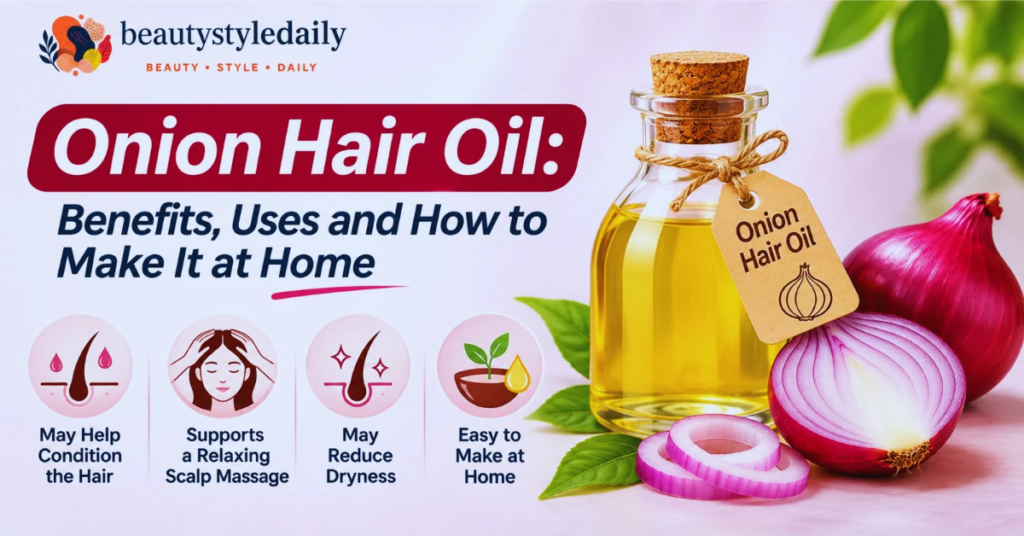
Onion hair oil is a popular hair-care product used by people who want to improve the look and feel of their hair. It is commonly marketed for scalp care, stronger-looking strands and hair growth. You may find ready-made onion oils in shops or make a simple version at home. However, popularity does not prove that onion oil can regrow hair or prevent hair loss, and the evidence for onion oil itself is limited.
If you are considering onion oil for hair, focus on realistic expectations, safe use and the needs of your scalp. This guide explains its potential benefits, how to make a basic oil at home, how to apply it and what to consider before trying it.
What Is Onion Hair Oil?
Onion hair oil is an oil-based hair-care product made with onion extract or onion juice infused into a carrier oil. Commercial formulas may contain additional ingredients, while homemade versions vary widely. Onion contains sulphur-containing compounds and other plant compounds, but the presence of these substances does not by itself establish that an oil can improve hair growth.
It is also important to distinguish onion oil from onion juice. Some small studies have explored topical onion juice for particular conditions, but those findings cannot automatically be applied to every onion oil product or homemade recipe.

Potential Benefits of Onion Hair Oil
- May help condition the hair: The carrier oil in a formula can coat hair strands and may reduce friction, helping hair feel smoother and easier to manage. The conditioning effect depends on the oil and the hair type.
- Can support a massage routine: Applying oil with gentle fingertip movements may make a scalp-care routine feel relaxing. Avoid vigorous rubbing, which can irritate the scalp or cause tangling.
- May reduce dryness in the hair lengths: Some carrier oils can help soften dry lengths and ends. Apply only as much as you need and wash it out if it leaves heavy residue.
- Hair-growth claims remain uncertain: There is not enough strong evidence to conclude that onion hair oil reliably increases hair density, prevents shedding or reverses baldness. Results are not guaranteed.
Does Onion Oil Help Hair Growth?
Onion hair oil is often promoted as a natural hair-growth solution, but research on onion oil is limited. A small study has examined crude onion juice for a specific type of patchy hair loss, but onion juice is not the same as commercial or homemade onion oil. That study should not be treated as proof that onion oil works for common hair thinning or every cause of hair loss.
Hair shedding can be related to genetics, hormonal changes, illness, stress, medicines, nutritional deficiencies or scalp conditions. If you are experiencing ongoing or sudden hair loss, a dermatologist can help identify the cause and discuss treatments supported by evidence.
How to Make Onion Hair Oil at Home
A homemade onion-infused oil is easy to prepare, but mixtures containing fresh onion or water can spoil. The method below is for a small batch intended for prompt use, not long-term storage.

Ingredients
- 1 small onion
- 4–5 tablespoons of a carrier oil such as coconut or olive oil
- A clean pan, blender and fine strainer
Preparation steps
- Peel and finely chop the onion.
- Warm the carrier oil over very low heat in a clean pan. Do not let it smoke.
- Add the chopped onion and heat gently for a short time, stirring carefully. Avoid browning or burning the onion.
- Turn off the heat and allow the mixture to cool completely.
- Strain out all onion pieces using a clean, fine strainer.
- Use a small amount promptly and discard the remainder. Do not assume that a homemade mixture is shelf-stable or safe to store for weeks.
For a safer and more predictable option, choose a commercially prepared product from a reputable manufacturer and follow its label. Do not use a homemade mixture if it smells unusual, changes appearance or may have been contaminated.
How to Apply Onion Hair Oil
- Read the product label first, especially if you are using a commercial formula.
- Patch test a small amount on a small area of skin and follow any instructions provided with the product. Do not use it if redness, itching, swelling or burning develops.
- Apply a small amount to the scalp or hair lengths, depending on the product directions and your own tolerance.
- Massage gently with your fingertips. Do not scratch or rub hard.
- Leave it on only for the time recommended on the product label. If using a homemade oil, keep the first application brief and rinse it out if irritation occurs.
- Wash the oil out thoroughly with a suitable shampoo if needed.
How Often Should You Use Onion Hair Oil?
There is no scientifically established schedule for onion hair oil. If you choose to try it, begin occasionally rather than applying it every day. Adjust based on how your scalp responds, and stop if you develop itching, redness, bumps, flaking or discomfort. More frequent use does not mean better results.
Who Should Avoid Onion Hair Oil?
- People with a known allergy or sensitivity to onion or any ingredient in the product.
- Anyone with a sore, broken, inflamed or infected scalp until the condition has been assessed.
- People who develop burning, swelling, itching or a rash after application.
- Anyone who finds the product worsens dandruff, irritation or scalp discomfort.
Keep oil away from the eyes. If it enters the eyes, rinse with clean running water. Seek medical advice if a reaction is severe or does not settle.
Onion Hair Oil vs. Commercial Onion Oil Products
Products marketed as onion hair oil differ in formulation. Some contain onion extract, while others use a blend of carrier oils, fragrance and additional ingredients. Check the ingredient list, manufacturer information, directions and warnings instead of choosing a product based on the word “onion” alone.
Mamaearth, WOW and other brands may sell products under this category, but formulations can change. This guide does not endorse a particular brand or verify that any one product promotes hair growth. Read the current packaging and choose a product suited to your scalp.
Tips for Healthier-Looking Hair
- Use a shampoo suited to your scalp and conditioner on the hair lengths.
- Limit high-heat styling and repeated chemical treatments.
- Avoid tight hairstyles that pull on the roots.
- Eat a balanced diet with adequate protein and varied nutrient-rich foods.
- Avoid taking high-dose supplements unless a healthcare professional recommends them.
- Seek advice for sudden shedding, bald patches or persistent scalp symptoms.
When Should You Consult a Dermatologist?
Consult a dermatologist if hair loss is sudden, severe, persistent or accompanied by bald patches, scalp pain, redness, scaling or intense itching. A clinician can assess possible causes and discuss appropriate options. Do not delay care while trying onion oil or other home remedies if the hair loss is significant.
Frequently Asked Questions
Is onion hair oil good for hair?
It may condition hair depending on its carrier oils, but strong evidence that onion hair oil promotes hair growth is lacking.
Can onion oil regrow hair?
It has not been established as a reliable hair-regrowth treatment. The limited research on onion juice cannot be assumed to prove that onion oil works.
Can I leave onion hair oil overnight?
Follow the product label. Overnight use is not necessary, and prolonged contact may irritate some scalps. Avoid it if you notice discomfort.
Can I use onion hair oil every day?
There is no established need to use it daily. Start occasionally and stop if irritation or buildup occurs.
How do I make onion oil for hair at home?
A small amount of onion can be gently warmed with a carrier oil and then strained. Homemade mixtures containing fresh ingredients can spoil, so prepare a small batch and do not store it for long periods.
Is onion oil suitable for every hair type?
Not necessarily. Scalp sensitivity, allergies and hair-care needs differ. Patch test and stop if a reaction develops.
Does onion oil stop hair fall?
There is not enough strong evidence to say it reliably prevents hair loss. Persistent shedding should be assessed to identify its cause.
Which is better: onion juice or onion oil?
They are different preparations, and evidence for one cannot automatically be applied to the other. Neither should replace assessment or treatment for ongoing hair loss.
Final Thoughts
Onion hair oil may be used as a conditioning step in a hair-care routine, but it should not be treated as a proven cure for hair loss. If you try it, choose a product carefully, patch test, use it gently and stop if irritation occurs. For persistent shedding or thinning, getting the cause assessed by a dermatologist is more useful than relying on a home remedy alone.